

In this installment of The Algorithmic, we’re bringing you a fresh post in the Model Roundup series. The past couple of weeks have been intense, with big announcements from Google, Microsoft and Mistral, as well as new models popping up two or three times a day. Some of these models (like Mamba and StripedHyena) even have innovative new architectures trying to dethrone transformer-based LLMs. We’ve got a lot to cover, so let’s dive in!
We discuss licenses for some of these models, but remember we’re tech people, not lawyers. Just to get the boilerplate (from the actual lawyers) out of the way:
The information provided on this website does not, and is not intended to, constitute legal advice; instead, all information, content, and materials available on this site are for general informational purposes only.
Google Gemini

The biggest announcement from the past few days was Google’s unveiling of their long-anticipated LLM series, Gemini. Unfortunately, Google is off to a mildly inauspicious start with Gemini. Between less-than-fully-honest comparisons against OpenAI’s GPT-4 in their technical report and a demo video showcasing features that don’t (yet) exist, Gemini has been greeted with a strong dose of skepticism. Make no mistake though, the Gemini models are top-quality. Whether Gemini Pro (the largest in the Gemini family) is better than GPT-4 is a matter of debate.
However, the more interesting question isn’t whether the model Gemini Pro is better than the model GPT-4, but rather if Google’s Gemini-powered products turn out to be better than ChatGPT and Microsoft’s GPT-4-powered products. For now, the dust is still settling on that issue. The good news is that there’s more competition in the LLM market to help drive innovation and lower prices.
Microsoft Phi-2

A few days after the Gemini release, Microsoft announced the latest in their Phi series, Phi-2. The purpose of the Phi models is to show how capable “small” LLMs can be when trained on high-quality data. Unfortunately, Phi is subject to a strict research-only license, so unless you plan on doing LLM research, there’s not much worth doing with it (especially considering there are comparable-or-better models that can run on consumer hardware at about the same speed).
If you’re looking to try it out, the model weights can be found here.
Stable Zero123
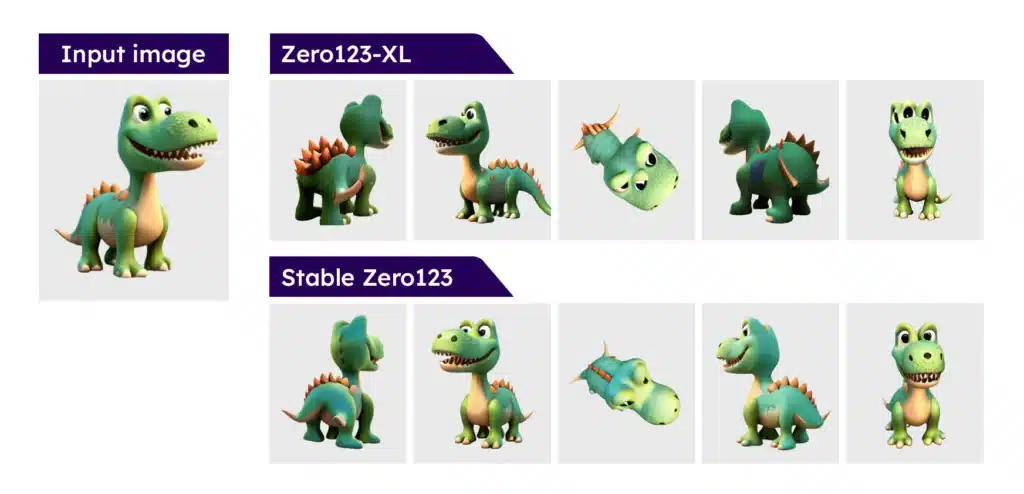
Stability AI has been flooding the AI news cycle with announcements lately. Their latest announcement is Stable Zero123 (model weights here) an image-to-3D model based on the paper Zero-1-to-3 from a research group at Columbia University. As has been the case with Stability’s most recent models, Stable Zero123 isn’t licensed for commercial use (in other words, expect Stability to offer a product using the model sometime in the near future).
Segmind Diffusion Models

Segmind (the same group that brought us SSD-1B) has released Segmind-Vega, a streamlined version of Stable Diffusion XL (SDXL), offering a 70% reduction in model size and twice the inference speed. Results seem to be on-par with SDXL and Segmind-Vega has an Apache 2.0 license, so feel free to use it for commercial purposes. They also released Segmind-VegaRT, a distilled consistency adapter that claims to reduce the number of Segmind-Vega’s inference steps to between 2 and 8 steps (bringing its overall speed close to SDXL Turbo). Neither appears to work out-of-the-box through Automatic 1111, so get ready to build a ComfyUI workflow or write a bit of Python code if you want to use this one.
Playground Diffusion Models

Playground AI has released a new text-to-image model, Playground v2 – 1024px Aesthetic. According to Playground, this model produces much higher-quality results than SDXL for a similar compute cost. The model license has a couple of caveats to pay attention to, but commercial use is permitted.
And did we mention that only days later @artificialguybr released a finetune, called Ludica? Although the improvement from the finetune is modest, Ludica is much easier to say than “Playground V2 – 1024px Aesthetic.” The model has a standard BigScience OpenRAIL-M license (a subclass of Responsible AI Licenses [RAIL]), which also allows for commercial use.
Both of these models use the standard Stable Diffusion pipeline and should be compatible with your Stable Diffusion software of choice.
More from @artificialguybr

Also worth mentioning from @artificialguybr is the first-ever finetune of Pixart-Alpha-1024-MS, named Fascinatio.Redmond. No license information was given for the finetune, so we can only assume Pixart-Alpha-1024-MS’s OpenRail++ license applies. Considering the ambiguity, you may want to consult a lawyer before using this one for commercial purposes. Also, keep in mind that Pixart doesn’t use the Stable Diffusion pipeline, so you’ll need to use image generation software that it’s compatible with (such as the inference code on the Pixart GitHub, Biniou or direct Python code).
LLM360

One exciting development that almost managed to fly under the radar among all the other big news is LLM360‘s release of their Amber, AmberChat and CrystalCoder models. These LLMs are, to the best of our knowledge, the first completely open source LLMs. This means the model weights, training code, training data and data preparation code are all available and permissively licensed (Apache 2.0). Until now, plenty of models and datasets have been released with permissive licenses, and a couple of projects have made their model training and data preparation code available, but LLM360’s are the first to release everything and give it a permissive license. Even if these models were mediocre (which they aren’t), their openness alone would be exciting. But the extra good news is that these models aren’t just open, but also quite capable. Definitely give them a try.
Mamba

For about three days Mamba had the entire AI world rushing to read up on state space models (SSMs). Mamba is an LLM that doesn’t use transformers. Rather, they use a novel state space architecture that allows for sequence modeling without the drawbacks of transformers (such as context length and quadratic runtime). Mamba may have been upstaged once Mistral made their big announcements, but Mamba (and its various fine-tunes) are worth trying out and definitely worth reading up on.
Some fine-tunes of Mamba worth checking out:
- clibrain/mamba-2.8b-instruct-openhermes
- clibrain/mamba-2.8b-chat-no_robots
- havenhq/mamba-chat
- typeof/mamba-130m-instruct
- Schmadge/mamba-slim-orca
StripedHyena

Mamba wasn’t the only LLM in the past few days to reach competitive performance without transformers. StripedHyena (and StripedHyena-Hessian) stepped onto the scene shortly after Mamba, using a signal processing approach to sequence modeling. It didn’t get the same level of attention Mamba briefly enjoyed, but StripedHyena has a fascinating architecture and solid performance that are definitely worth checking out.
Mistral and the Mixture-of-Experts Craze

Mistral may not be as big as OpenAI, Google or Microsoft, but they managed to get everybody talking with their model releases and announcement of their first commercial offering. The thing that has everybody talking is their Mixtral-8x7B models. These models are a mixture-of-experts (i.e., a collection of smaller LLMs that route prompts between them in an intelligent way). At 84GB total (and needing extra VRAM for inference) these models won’t run on lowly consumer hardware. However, some of the quantized versions from Tom Jobbins (@TheBlokeAI) should just barely fit on high-end gaming GPUs. The thing about Mixtral-8x7B that’s so impressive is that it’s an open model that reaches GPT-3.5 levels of performance. This has half the AI community rushing to train fine-tunes, each edging out the last for even better performance.
This comes alongside the announcement of Mistral-7B-Instruct-v0.2, the new version of Mistral’s 7 billion parameter model (i.e., an LLM in that sweet spot where you can get good performance while still being able to run it on consumer hardware).
Here are the base models and some of the more interesting finetunes that have popped up since Mixtral was released:
- mistralai/Mixtral-8x7B-v0.1
- mistralai/Mixtral-8x7B-Instruct-v0.1
- someone13574/mixtral-8x7b-32kseqlen
- DiscoResearch/DiscoLM-mixtral-8x7b-v2
- mattshumer/mistral-8x7b-chat
- migtissera/Synthia-MoE-v3-Mixtral-8x7B
- ehartford/dolphin-2.5-mixtral-8x7b
Also Worth Mentioning

Before we go, we’d like to give a huge shout out to the hard-working devs at Huggingface, who have been working round-the-clock to integrate new architectures into Transformers and make all of these new LLMs more widely-available.
Also, Tom Jobbins (@TheBlokeAI) deserves immense respect. He probably never sleeps because he produces quantized versions of the most popular models almost immediately.
Lastly, we want to share out the list of models we didn’t have time to go over in detail. There have been so many fantastic new models released over the past couple of weeks, we didn’t have space to dig in on all of them. Here are some other recently-released models that you should definitely give a look-see:
- Weyaxi/Seraph-7B
- Deci/DeciLM-7B
- Deci/DeciLM-7B-instruct
- migtissera/Synthia-7B-v3.0
- TIGER-Lab/MAmmoTH-7B-Mistral
- The Archangel model series from ContextualAI
- distil-whisper/distil-large-v2
- Nexusflow/NexusRaven-V2-13B
- upstage/SOLAR-10.7B-v1.0
- upstage/SOLAR-10.7B-Instruct-v1.0
Thanks for stopping by. We’ll see you next time, with the latest in AI news, tutorials and perspectives.